
Here's the thing about sales prospecting software: everyone complains about subscription prices, but those are rarely what actually costs you money.
I'm a procurement manager at a mid-sized B2B company. For the past 6 years, I've managed our sales tech budget—roughly $180,000 in cumulative spending—negotiated with 30+ vendors, and documented every order in our cost tracking system. When I hear sales leaders say 'our tools are too expensive,' I understand the instinct. I've sat through the same budget reviews. But after auditing our 2024 spending line by line, I can tell you: the price tags were only the beginning.
The Surface Problem: Everyone Points at the Price Tag
The obvious problem looks like this. A modern prospecting stack includes LinkedIn Sales Navigator for discovery, a contact database, an enrichment tool, email verification, a CRM, and an automation layer. On paper, our stack cost about $4,800 per month for a team of 12. That's $58,000 a year. Real money, especially when your CFO keeps asking why sales has more subscriptions than any other department.
The natural reflex is to shop for cheaper alternatives. That's honestly how Phantombuster first ended up on my radar. When I looked at Phantombuster's LinkedIn scraping pricing, my first thought was: 'okay, this is refreshingly reasonable compared to what we're paying.' A no-code platform that pulls leads from LinkedIn, Instagram, TikTok, and Google Maps? The price was the first thing I noticed. Well, the price and the fact that we could test it with a free trial without talking to a salesperson.
But it took me a while to understand that the subscription price was the least meaningful number in the entire equation.
The Deep Cause: Workflow Fragmentation, Not Tool Pricing
It took me 3 years and about 40 vendor evaluations to fully grasp this: the expensive part of a prospecting stack isn't the software. It's the workflow around the software.
Every time a human manually moves data from one tool to another, that step has a cost. Every time a lead sits in a spreadsheet instead of your CRM, the delay has a cost. Every time someone uses a 'free' email verifier with questionable accuracy, the gamble has a cost. None of these costs show up on a vendor invoice, but they show up in your team's time.
A concrete example from Q2 2024. I compared two approaches for an outbound campaign. Approach A was the budget path: use the tools we already had, export leads from Sales Navigator by hand, enrich them, verify emails with a free tool, then paste everything into a spreadsheet for the SDR team. Approach B was an integrated setup with a slightly higher monthly cost but no manual handoffs.
When I calculated total cost of ownership—not just subscriptions, but labor, error rates, and time-to-outreach—Approach A lost by a wide margin. The manual version took about 45 minutes per qualified lead. Actually, closer to an hour when you count the back-and-forth with the free verifier. At a $40/hour fully loaded cost for an SDR, that's $30–40 of labor per lead before outreach even happens. A 500-lead campaign would burn $15,000–20,000 in labor just moving data around. Approach B, which cost maybe $150 more per month in subscriptions, cut the manual time down to about 10 minutes per lead. The math wasn't even close.
The 'free' email verifier made things worse. We tested it on 500 known-good addresses. Well, 'known-good' as far as we could verify at the time. It flagged about 20% as invalid—false negatives—while also letting through a handful of bad ones. The false negatives cost us good leads; the false positives cost us deliverability. That free tool was arguably more expensive per use than anything else in our stack.
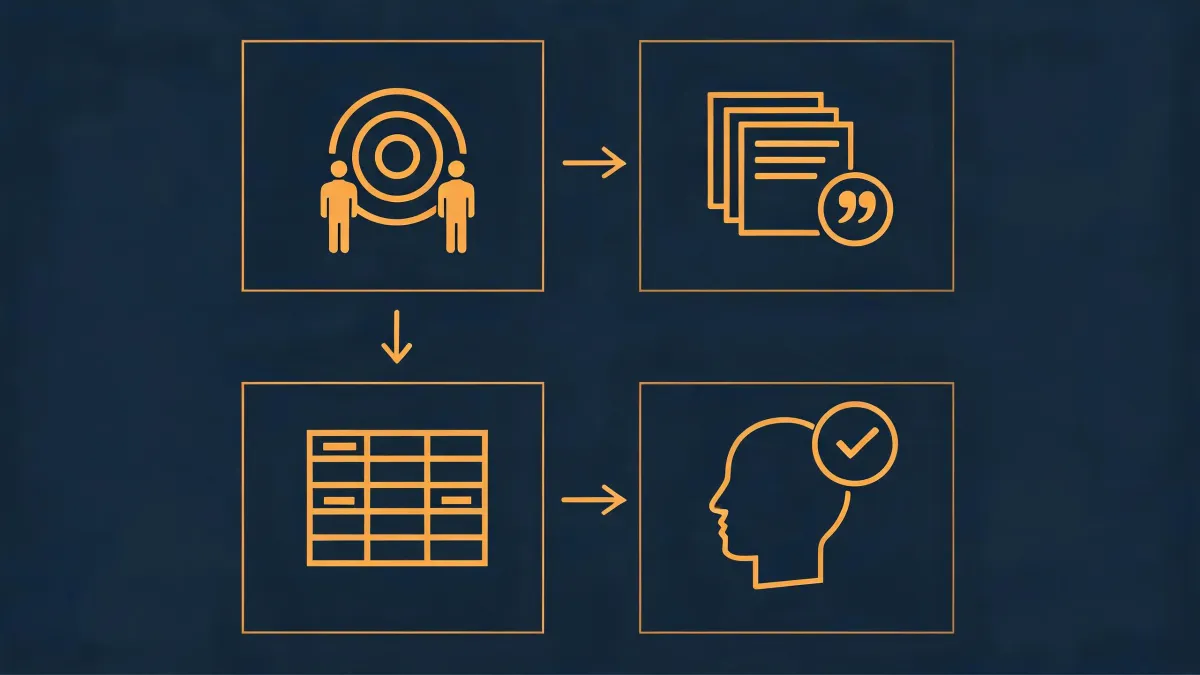
The deeper pattern only became clear when I mapped the full workflow as a process diagram, the same kind we use for manufacturing. The real cost driver was something factory managers know well: work-in-process inventory. Leads sitting half-moved between tools, waiting for a person to carry them across the next handoff. Every handoff was a line item that never appeared on any invoice.
In fact—and this was the realization that changed my approach—when I audited our 2023 numbers, tool subscriptions accounted for only 23% of the total cost of producing one qualified lead. The other 77% was labor, manual cleanup, bounced emails, duplicate entries, and the opportunity cost of SDRs doing admin work instead of selling.
The Cost of Ignoring This Is Bigger Than the Budget
If you don't fix the handoff problem, the consequences extend well beyond a budget line.
First, you're paying for waste that compounds. The 77% figure wasn't a fluke—it held up across multiple years. That's what told me it was structural, not situational.
Second, and this is where it gets interesting, you're crippling your ability to act on sales triggers. A sales trigger is an event that signals timing: a prospect changes jobs, visits your pricing page, or starts posting about a problem you solve. Triggers decay fast. If a decision-maker's job change is detected on Monday but doesn't reach your CRM until Friday because a human had to move it, the trigger is basically dead.
When people ask me how sales leads fit into an agent-native prospecting workflow, I frame it like this: leads are the fuel, and triggers are the ignition. The smartest AI agent orchestration in the world produces garbage if its inputs are stale, unverified, or late. The leads that arrive through manual export and copy-paste are the most expensive fuel you can burn.
And here's the part that bothers me the most—the burden falls hardest on small teams. Enterprise buyers can throw money at fragmentation: all-in-one platforms, a RevOps person to manage integrations, premium data, professional services. Small teams can't. They're told to use free tools and be scrappy. Sounds sensible until you count the hours.
I helped a startup founder audit their stack once. Eight employees, always bootstrapping, proud of keeping SaaS spend under $200/month. It took about an hour to find the real cost: the team was collectively spending 10+ hours per week on manual workarounds. At the lower end of startup salaries, that's roughly $40,000 a year of wasted time. The founder said something I'll never forget: 'I thought I was being cheap, and it turns out I'm paying double.'
In my opinion, confusing 'low monthly spend' with 'low total cost' is the most common—and most expensive—mistake a small team can make. It's also the one that's easiest to fix.
What Actually Worked (It Wasn't Cheaper Tools)
I'm not a sales operations specialist, so I won't pretend to give a masterclass in agent orchestration. What I can tell you, from the procurement side, is how we fixed the cost structure.
We stopped asking 'which tool is cheapest?' and started asking: 'what's the cheapest complete path from lead discovery to a verified, CRM-ready contact?'
That reframing changed everything.
Phantombuster made the cut not because its pricing is the lowest—it isn't, and I wouldn't expect it to be. What I liked was that Phantombuster's LinkedIn scraping pricing is usage-based and transparent, which makes total cost predictable. But more importantly, it eliminated handoffs. The workflow now looks like this: a trigger fires, Phantombuster extracts the profile data, the Phantombuster Make integration pushes it through enrichment and verification, and the verified lead lands in our CRM right away.
No CSV files. No manual exports. No spreadsheet purgatory.
We also enforced a painful but necessary rule: stop choosing verification tools based on 'free.' Sender reputation is a long-term asset. A free email verifier with mediocre accuracy is betting years of domain credibility for a savings of a few dollars a month.
The outcome: the same team that spent 45 minutes per lead now spends 5–10, and most of that is actual prospecting, not data shuffling.
So if you're evaluating prospecting tools, take it from my procurement seat: map the full path from lead discovery to outreach. Count every time a human touches the data. Put a fully loaded cost on each touch. Then compare tools based on how many touches they eliminate—not which one has the cheapest-looking monthly fee.
The tools that save money are the ones that connect cleanly with the rest of your stack. And the vendors that survive our budget reviews are the ones who treat their smaller customers like they matter. It's not charity. Today's $50/month user might be next year's $500/month user. I've stuck with vendors who took my early small orders seriously, and I've dropped ones who made me feel like a nuisance.
For everyone else on the buying side: the goal isn't fewer tools. It's fewer handoffs.