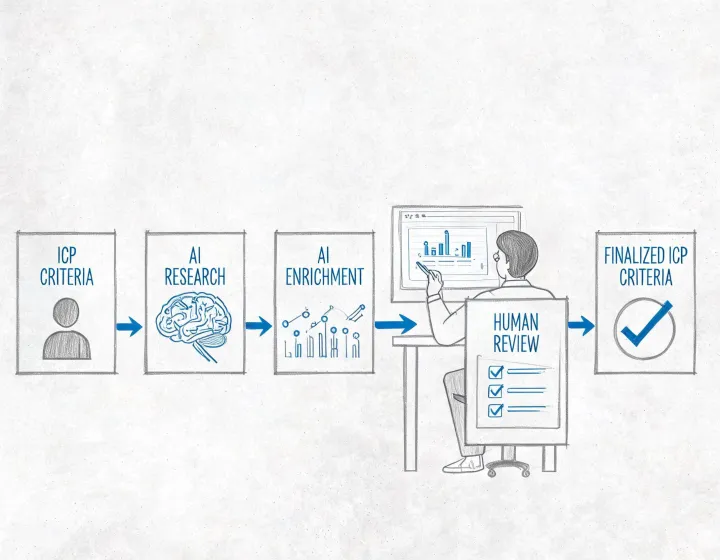
Define the research contract
Translate the market thesis into firmographic and technographic criteria, territory, exclusions, evidence thresholds, and intended use. Observed facts stay separate from inferred fit. Missing fields remain visible rather than becoming confident guesses, giving RevOps a stable brief to reproduce and audit.
Collect with provenance
Research accounts, roles, hiring activity, product changes, and other public intent signals while recording source context and retrieval timing. Treat contact enrichment as a distinct stage. A waterfall may increase field coverage, but it also adds provider cost, conflict resolution, rate limits, and deletion paths.
Review before outreach
Keep targeting, contact choice, message drafting, suppression, and sending as separate decisions. A human reviewer checks relevance, factual accuracy, regional rules, provider terms, and approved channels. Verification reduces one uncertainty; it never guarantees inbox placement, replies, consent, or compliance.
Measure on your own sample
Use a labeled set to measure accepted matches, evidence completeness, reviewer overrides, research time, provider spend, and downstream outcomes. Avoid universal accuracy claims because results change with segment, geography, query design, source freshness, runtime, and reviewer standards.