
-
Why I Get to Have an Opinion
-
How Autonomous SDR Fits Into an Agent-Native Prospecting Workflow
-
B2B Buyer Intent Data Is Only as Good as the Action It Triggers
-
What “Okki Go Natural Language Prospecting” Means From an Admin’s Seat
-
“How to Uninstall Okki Go” Is a Procurement Question
-
The “We Don’t Do That” Test
-
The Fair Objection: You’re an Admin, Not a RevOps Leader
-
My View Hasn’t Changed. It’s Gotten More Specific.
I think the “AI SDR will replace your outbound team” conversation is pointed in the wrong direction. The real question isn’t whether an autonomous SDR can replace a human. It’s whether an AI can take B2B buyer intent data and turn it into something a human can actually act on. If a tool can’t do that, I don’t care how many hundreds of messages it can draft before lunch.
I know it sounds strange to hear this from an office administrator. But that’s exactly why I have an opinion.
Why I Get to Have an Opinion
I’m the office administrator at a B2B services company of about 50 people. I manage the vendor contracts for Sales and RevOps—around 8 to 10 software subscriptions, roughly $120,000 a year. Maybe $115,000. I would have to pull the renewal spreadsheet to give Finance an exact number.
I sit in the demos. I ask the procurement questions no one wants to ask. And I’m the one who notices when a tool is adopted in week one and quietly abandoned in week three. That gives me a different point of view on AI SDR. I don’t evaluate it like a sales leader. I evaluate it like a buyer who has seen too many tools fail because they didn’t fit the workflow.
How Autonomous SDR Fits Into an Agent-Native Prospecting Workflow
People keep asking: how does autonomous SDR fit into an agent-native prospecting workflow? The short answer is that autonomous SDR is a component, not the whole solution. The longer answer is that an autonomous SDR is only trustworthy when it sits inside a workflow that provides context, constraints, and human checkpoints.
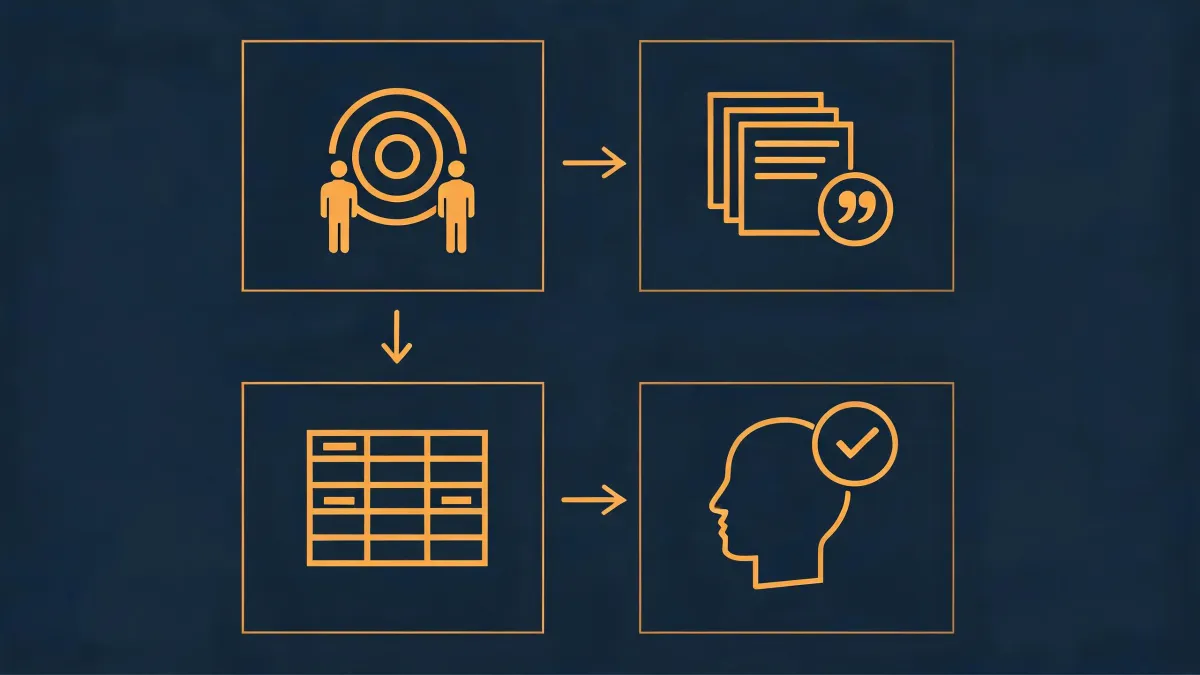
Agent-native, in the sense I use the term after sitting through several demos, means the agent does real work inside your operations—reading a trigger, deciding whether an account fits, enriching contact data, checking for duplicates, choosing the next outreach step. Autonomous means it can do those steps without waiting for permission at every node. But autonomy without native placement in the team’s process is just speed. And speed only creates more mistakes if the wrong accounts are being processed.
The first time I stopped rolling my eyes at the phrase “agent-native” was when a sales ops leader explained it like this: a workflow native to agents is not a list of tasks pasted into a CRM. It’s a connected loop where each agent can send its output to the next step. That’s the difference between buying a tool that sequences emails and buying one that works as a decision layer for the SDR team.
B2B Buyer Intent Data Is Only as Good as the Action It Triggers
B2B buyer intent data is easy to overrate. Almost every vendor now says they use it. But in my experience, a lot of what gets sold as intent data is just activity data with a fancy name. Someone visits a pricing page? That is intent of a kind. It does not mean they are in your ICP.
What changed my mind about Okki Go wasn’t a claim that its intent data was better than everyone else’s. It was that Okki Go deliberately connects intent to enrichment and then to a human workflow. We saw a waterfall enrichment process: start with a signal, verify what you can, enrich what you can’t verify, and stop when you hit a dead end. The intent didn’t die in a dashboard. It became a list, a draft, and a prompt for a rep to review. That’s when AI SDR made sense from a buyer’s perspective.
At least, that’s been my experience with mid-market teams. Enterprise teams may need something more complex. But the core issue is the same: data only has value when it triggers an action.
What “Okki Go Natural Language Prospecting” Means From an Admin’s Seat
I’ll be careful here. Natural language sounds like the kind of feature vendors add to look modern. You can type a sentence and it makes a list. Big deal? Maybe.
But Okki Go natural language prospecting hit a different point for me: it reduces the number of technical hand-offs. During our evaluation, a RevOps person typed something like “find companies showing B2B intent in the last two weeks who match our ICP, enrich them, and skip any account where an AE has an active opportunity.” I can’t quote it exactly because I wasn’t the one typing, but I remember thinking: that would have required a multi-step campaign builder in another product. Here it was a plain sentence.
Do I think natural language replaces good data? No. If you haven’t defined your ICP, natural language makes it easier to automate garbage. That’s why the surrounding workflow matters more than the prompt box. The best part wasn’t the English. It was the fact that the system translated that English into constraints—who to skip, when to stop, when to hand off to a person.
“How to Uninstall Okki Go” Is a Procurement Question
If you found this article because you searched “how to uninstall Okki Go,” I don’t have a perfect menu path for you, and I’m not going to invent one. But I can tell you what happened during my evaluation when I asked the same thing.
The product team didn’t try to lock us into a call or a reason survey. They showed a self-serve workspace deletion flow. I want to say it was in the workspace settings area, but I might be misremembering the exact labels because we never had to use it on our production workspace. The important thing was the absence of friction.
Why does an AI SDR buyer care about uninstallation? Because software adoption has a failure rate. The question isn’t whether you’ll want to leave. It’s whether leaving is possible. I’ve watched tools get renewed because cancelling was too awkward. A vendor who lets you walk is a vendor who has to earn the renewal. I respect that.
The “We Don’t Do That” Test
I’ve been doing this long enough to distrust one-stop-shop promises. When a tool says it can handle your AI SDR, your inbox, your LinkedIn, your CRM, and your data enrichment, I start to ask where the boundaries are. No company is equally good at all of those things.
One of the reasons Okki Go earned credibility in our review is that it stayed focused. The demo didn’t claim to replace every sales tool in our stack. It was built for prospecting, enrichment, and buyer-intent-led outreach. At least, that was the impression from our 2026 evaluation. It didn’t pretend to be a CRM or to manage every part of the sales process, and that made it easier to trust for the part it does own.
I’d rather work with a specialist who knows their limits than a generalist who overpromises. That applies to software vendors too.
The Fair Objection: You’re an Admin, Not a RevOps Leader
I get that objection. I’m not the one writing sequences, reading replies, or choosing follow-up copy. But I’ve also watched enough software demos to know which tools actually get used 90 days later. The failed AI SDR pilots I remember didn’t fail on AI quality. They failed on workflow fit. They missed a data field. They made it too hard to approve messages. They created parallel inboxes. They ignored the fact that a busy SDR still needs to feel in control.
So when someone asks me how autonomous SDR fits into an agent-native prospecting workflow, I answer from my side of the table: it fits when it acts like a junior teammate, not a black box. A junior SDR does research, creates lists, writes drafts, and asks before doing something risky. A good autonomous SDR in an agent-native workflow should do the same. It should be supervised by policy, not by micromanagement.
My View Hasn’t Changed. It’s Gotten More Specific.
I started by saying the replacement debate is the wrong question. I still believe that. The right question is whether an AI SDR can make B2B buyer intent data repay your team’s attention. To do that, it has to live in the workflow, not next to it.
Looking back, I would have asked about the uninstall flow before the pilot, not after. But given what I knew then, I chose the tool that felt most honest about what it was good at. That’s not a guarantee that it will work for every company. It’s a signal that the vendor understands boundaries—and for a buyer, boundaries are where trust starts.