
If your B2B sales team is spending more than a few hours a week manually scrolling LinkedIn Sales Navigator and copying contacts into a spreadsheet, the first tool you need is Phantombuster, not a contact data provider. In our 2024 vendor consolidation project, that order cut list-building time from about 9 hours a week to under 2. A contact data provider still belongs in your stack, but it should come after you know exactly who you're looking for. Phantombuster gets you to that point.
I'm saying this as the office administrator who buys sales tools, not as a sales operations consultant. I've managed software subscriptions for a 70-person company for 5 years—roughly $180,000 a year across 30 vendors. I report to both operations and finance. When I took over purchasing in 2020, one of the first things I learned is that sales tool vendors don't make money from software; they make money from people canceling after the first year. That's why I put every new tool through a real test before committing. When the sales director asked for a new lead generation tool in early 2024, I ran the evaluation.
Why Start With Phantombuster Instead of Contact Data
We initially considered buying a big B2B contact database. Sales reps said they wanted emails for thousands of prospects. But when I asked them to show me the target list, they couldn't agree on the filters. That's the problem: contact data providers are excellent for enriching a list you already built, but they're not great for helping you decide who belongs on the list in the first place.
That's where Phantombuster LinkedIn automation came in. We set up a Phantom that takes a saved Sales Navigator search URL, goes through the results, and exports the profiles to a CSV. I should note: this is not an API integration. We deliberately chose a no-code tool because our IT team was already overloaded. Phantombuster runs a browser for you. (Should mention: you'll need to be careful about session usage and not run it unattended for days. More on that in the caveats.)
Our first search was for "Head of Revenue" at Series A/B companies in the U.S. with fewer than 200 employees. In about an hour, we had a CSV of 340 profiles with public URLs. The manual equivalent would have been two full days for one rep. That's when I stopped thinking of Phantombuster as just another scraper and started seeing it as the foundation of our whole lead generation process.
I won't name the tool we used before this, but it was a cheaper LinkedIn scraper that required a part-time developer to keep running. We saved maybe $50 a month on paper. When LinkedIn changed its layout, the scraper broke and we lost a 1,400-contact export. Rebuilding that list cost us two weeks. The hidden cost didn't appear in any line-item comparison. That's the kind of thing you don't find until after the purchase.
What Contact Data Providers Actually Do
For anyone typing "what is contact data providers and when should a b2b sales team use it" into Google, here's the plain-language answer:
A contact data provider is a database of business people and their contact details. You use it to fill the gaps—email addresses, phone numbers, job titles, company size, sometimes intent signals. You don't use it to discover which companies are actually hiring a certain role this week. That data gets stale fast.
The moment we used Phantombuster to export a precise list from LinkedIn, the contact data provider became useful. We uploaded the CSV to a provider (we compared quotes from four vendors in June 2025) and got enrichment on about 70% of the rows. Then we ran the emails through Phantombuster's free email verifier—well, free in the sense that it's included in the plan. It caught formatting errors, bad domains, and missing MX records before anything got into Salesforce.
Never expected the email verifier to be the feature that saved the most time. I thought the LinkedIn search export was the star. Turns out finding bad emails before a sequence starts is more valuable than finding them after two weeks of bounces.
We didn't have a formal evaluation process for sales tools back then. That cost us when the first database vendor we tested sold us a list with a claimed 90% validity—only 18% of the emails bounced in a small test. After that, we created a rule: verify first, buy second.
The Workflow We Use Now
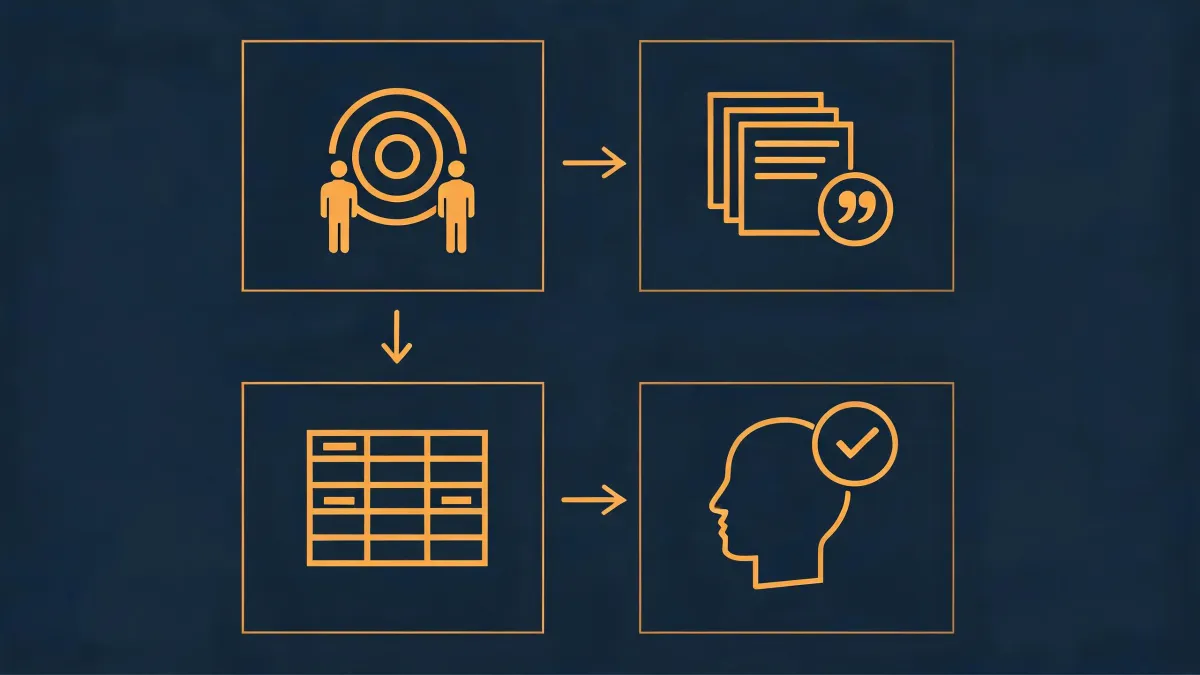
- Save a Sales Navigator search with tight fit criteria.
- Run the Phantombuster LinkedIn search export to pull profile URLs and basic data.
- Dedupe and review in Google Sheets, using the public profile URL to spot-check.
- Send the list through a contact data provider for email enrichment.
- Run the enriched emails through Phantombuster's email verifier.
- Upload the verified list to our CRM and trigger the sequence in Make.
That last integration matters. Phantombuster works with Make, Zapier, and n8n, so I don't have to touch the CSVs or ask a developer for help. In our 2024 workflow, a new verified list would trigger a Slack notification to the SDR team. For a non-technical administrator, that's rare. Most "automation" tools assume you have a developer on standby. This one didn't.
When Should a B2B Sales Team Use a Contact Data Provider?
Use a contact data provider when you already have the account list and you need accurate contact details. You know a manufacturing company in Ohio has 400 employees, and you want the procurement manager. A provider can get you that.
Don't use a contact data provider as your primary way to find companies that recently changed leadership or posted a new job. For that, LinkedIn is more current, and Phantombuster's search export lets you capture it the week you run the search.
The decision rule I use now: Discovery first, enrichment second. Discovery is your ICP, your territory, your title list. Enrichment is the email address and phone number. If you try to outsource discovery to a database, you end up with a lot of wrong people and low reply rates.
The Honest Caveats
I don't have hard data on how well Phantombuster's LinkedIn automation works for every account size or region. What I can say anecdotally is that it worked for us on searches up to around 2,500 results. Above that, we broke the search into smaller chunks. That's not a Phantombuster limitation—it's how you avoid rate limits and keep the account healthy.
Also, no automation tool can guarantee that your LinkedIn account will never have issues. We run Phantombuster at human speed, with delays, and only during business hours. We also avoid exporting sensitive information. The tool is a utility, not a magic wand. If a vendor promises "no risk," don't believe them.
Pricing? Don't hold me to this, but I'm fairly sure our Phantombuster plan is a middle tier that starts somewhere under $60 a month for our usage. As of June 2025, that's in the right range. Verify current pricing before you budget. The contact data provider costs more, and the free email verifier saves us from paying for bad data.
In March 2024, we paid an extra $400 for rush enrichment because a proof-of-concept for a new market had a hard deadline. It was worth every dollar. Missing that deadline would have cost us the deal. It confirmed my view: in sales operations, certainty has a price, and you should budget for it.
So glad we paid for that rush. We almost didn't. The experience is why I tell our reps that the cheapest path is rarely the one with the fewest surprises. When a vendor says "probably on time" or "should be mostly accurate," I translate that into "add a buffer and verify."
If you're evaluating Phantombuster for your B2B sales team, start with a free trial and run one of your own real searches. Export it, verify a few rows, and see what the data looks like. Then buy the contact data provider. At least, that's been my experience after 5 years of buying software for a company that can't afford bad lists.