
“Call me before you press next sequence.”
That message arrived at 4:12 p.m. on a Tuesday in early March 2026. No “hey,” no context — just our founder using the kind of phrasing that usually meant something had already gone wrong.
Three hours earlier, I had been in a product demo for another sales tool. I’d started quietly evaluating okki-go alternatives because our outbound pipeline had been flat for almost a month, and flat feels like falling when the board meeting is on Friday.
Then I opened the reply that killed the demo.
“Did you mean to send this to our VP of Engineering? He left in January. Also, that budget sits with me. Please remove my team from your list.”
It was signed by the IT director at a company we really wanted. The words were polite. The message underneath wasn’t: we were emailing strangers with wrong information, at scale, in the middle of a quarter we couldn’t afford to lose. Our one SDR had collected two similar replies in the same afternoon.
The email sequence looked fine. The list was not. And in outbound, list quality beats sequence copy every time.
The Okki-Go Human Review Workflow Was the Part We Skipped
Quick background. I run RevOps for a mid-market B2B SaaS company. We don’t have an enormous SDR team; we have one strong SDR and a lot of pipeline pressure. When we picked okkigo in late 2025, we didn’t need another database. We needed someone, or something, to do the boring parts of prospecting: the research, the enrichment, the verification, the first draft of an email sequence.
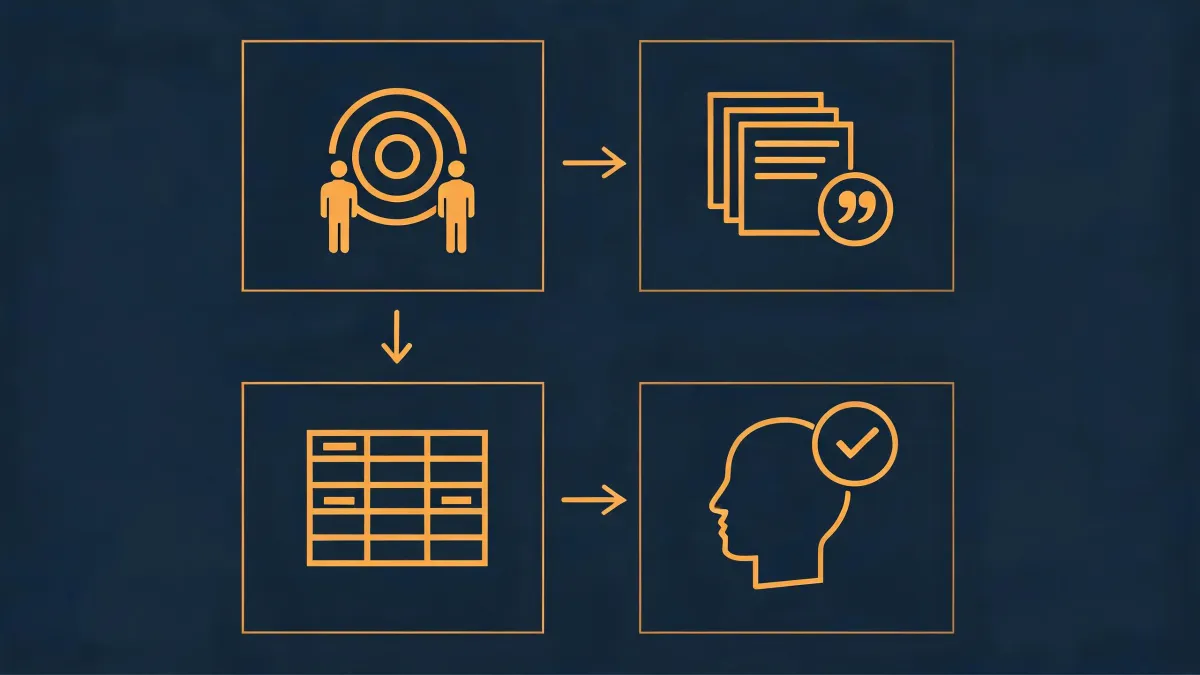
Okkigo calls this an agent-native prospecting workflow. I’ll translate: the AI works like an analyst, not like a typewriter. You give it context, it researches accounts, finds the patterns that suggest buying intent, enriches contact data, verifies what it can, and then proposes actual first-line messages. The output isn’t a spreadsheet dump. It’s a queue of prospects, each with a reason attached.
The critical step is what happens next: a human reviews that queue before the messages go out. That is the okki-go human review workflow. And it’s the step I almost removed because I was in a hurry.
I don’t want to oversell the complexity. We had volume targets. The queue was growing faster than we could check it. So I decided the review step could be fast-tracked for high-confidence contacts. The tool would still flag low-confidence records, but the “safe” ones would go out without waiting for a human.
That was the mistake. Confidence scores measure data completeness; they don’t measure whether a human being would be embarrassed by the message. In my case, the “high-confidence” records included a contact who had changed jobs two weeks earlier and a decision-maker who had never been the decision-maker at all.
What AI Sales Assistant Features Actually Fit Into the Workflow
One of the questions I kept asking while comparing tools was how AI sales assistant features fit into an agent-native prospecting workflow. I only got the answer after this crisis.
The features are for the work before the send. They should find the accounts, connect the dots, enrich the record, verify the email address, and draft a relevant message. They should not be the last person in the chain. The moment the AI talks to a stranger without a human being responsible for that contact, you aren’t doing outbound anymore. You’re gambling with your domain reputation.
I know the compliance side isn’t the blocker. Even under the FTC’s CAN-SPAM rule (ftc.gov), we had the basics right: truthful subject lines, a working opt-out, a physical postal address. But a prospect doesn’t click “report spam” because you violated a rule. They click it because they’re annoyed. Rules don’t repair trust.
When I tell people what happened next, they expect me to describe a new tool that saved us. There wasn’t one. We paused every sequence, opened the review queue we had ignored, and spent a long, uncomfortable day looking at individual contacts. We deleted whole segments that were technically in our ICP but realistically not ready to buy. We rewrote the messages that sounded like a robot had read a press release.
The fix wasn’t a feature. It was the human review workflow we already had.
What the Email Sequence Looked Like After We Turned Review Back On
For the next two weeks, our email sequence volume dropped by a lot. That felt terrifying at first. Then the replies started to change.
The first useful reply came from a company we had been trying to reach for months. The person wrote: “I normally delete cold email, but this was specific enough that I’ll give you 15 minutes.” That one reply did more for our pipeline than the previous three weeks of automatic sends had done.
So glad we made that call. If we hadn’t turned review back on, we would have walked into Friday’s board meeting with a domain heading toward spam and a list of prospects who now associated our brand with careless outreach.
I’m not going to quote reply-rate numbers here, because reply rates without context are useless. What I can tell you is this: the ratio of relevant conversations to “wrong person” replies improved dramatically. We booked real meetings from sequences that were smaller, slower, and reviewed by a human.
If You’re Searching for Okki-Go Alternatives, Read This First
Fair warning: this is the part where I admit I was looking. I had a spreadsheet of okki-go alternatives, and most of them are legitimate tools. Some have larger databases. Some have cheaper entry plans. I’m not going to criticize them by name because the problem was never their software.
The problem was our workflow. I had removed the only gate that forced a human to look at what an AI was about to say. If I had plugged any other lead generation software into the same broken process, we would have had the same breakdown.
So if you are genuinely evaluating okki-go alternatives, here’s the checklist I would use:
- Where does the human review actually happen? Is it built into the workflow or bolted on as an afterthought?
- Can you see why the agent chose a specific account and contact? Not just “high intent,” but the actual source?
- What happens if a contact changes jobs between enrichment and send? Does the sequence pause, or does it fire anyway?
To be fair, okkigo isn’t the only tool with some version of this. But after the emergency, I stopped caring about which tool could send the most emails. I cared about which tool could help us send the right email, to the right person, with a human in the loop.
The Honest Limit of What I Learned
I have one caveat. My experience comes from a fairly specific context: mid-market B2B SaaS, a two-to-six-week sales cycle, and a single outbound team of two people. I can’t tell you how this applies to enterprise sales, or to high-volume lead generation at a much bigger company. Your mileage will legitimately differ.
And honestly, I’m still not sure how much of the improvement came from cleaner data and how much came from the human rewrites. It was probably both. What I do know is that they both happen in the same place: the okki-go human review workflow.
Before this, I would have told you the goal of lead generation software is to find more contacts. Now I think the real goal is to help you figure out which contacts deserve a human’s attention. The AI can do the finding. Only a person can do the caring. Okkigo’s agent-native workflow gave us both — but only after we let the human back in.