
-
Dimension 1: Okki Go configuration vs stitched-together tools
-
Dimension 2: Okki Go cost vs total cost of ownership
-
Dimension 3: Lead generation capabilities—agent-native vs list-based
-
Dimension 4: B2B contact database—coverage vs freshness
-
Dimension 5: How email verifier features fit into an agent-native prospecting workflow
-
Which should you choose?
I review outbound assets before they reach customers. That includes sequences, prospect lists, vendor deliverables, and the configuration inside tools like Okki Go (often written okki-go). I've rejected about 18% of first deliveries in 2025—not because the teams were careless, but because the spec was vague, the data was stale, or the workflow did something the sales team didn't expect.
This is a comparison. Not 'Okki Go good, everything else bad.' I'm comparing two ways to run B2B prospecting:
- Option A: Okki Go as an agent-native prospecting workflow—waterfall enrichment, intent signals, B2B contact data, email verification, and human-in-the-loop outreach in one configured system.
- Option B: A conventional stack—a standalone B2B contact database, separate enrichment tools, a standalone email verifier, and manual handoffs between them.
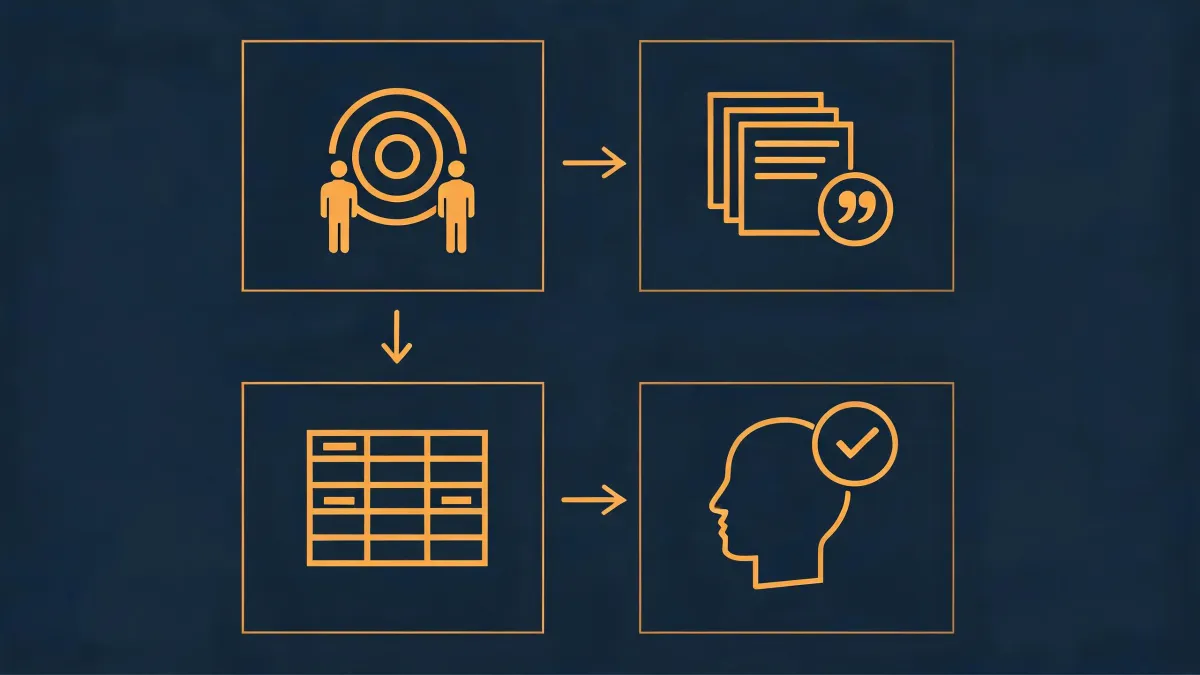
I'll compare five dimensions: configuration, cost, lead generation capabilities, B2B contact database quality, and where email verifier features actually fit. Then I'll give scenario-based advice. No absolute winner.
Dimension 1: Okki Go configuration vs stitched-together tools
Okki Go configuration usually means deciding seats and roles, ICP filters, waterfall enrichment order, intent thresholds, verification gates, suppression rules, CRM sync, and where a human must approve before send. The advantage is fewer handoffs. The risk is configuration drift: one person changes an ICP filter, another changes a verification threshold, and nobody documents it.
A conventional stack gives you more visible seams. You can see exactly which tool enriched a field and which verifier flagged a record. That transparency is real. But it also creates integration drift. I've seen an automation handoff drop a suppression flag—and 400 contacts went into a sequence that should have excluded them.
Sales said 'agent-native.' RevOps heard 'autonomous SDR.' Result: the workflow sent without approval, and we spent a week repairing domain reputation.
That's a communication failure, not a product failure. The lesson: in Okki Go, document every gate. In a conventional stack, document every handoff. Verdict: Okki Go wins on fewer moving parts; conventional wins on auditability if your team already has mature RevOps processes. If you can't document configuration, neither will save you.
Dimension 2: Okki Go cost vs total cost of ownership
People search for 'okki go cost' expecting a flat number. In my experience, Okki Go pricing is configuration-dependent: seat count, contact or enrichment credits, verification volume, intent data access, outreach channels, API usage, and onboarding/support. Ask for a line-item quote. If a vendor won't break it down, that's a quality issue.
The conventional stack often looks cheaper upfront because you buy each piece separately. But the total cost includes:
- Database subscription and refresh fees
- Enrichment credits—often wasted on records that fail verification later
- Email verification re-runs after list decay
- Ops time to stitch tools and fix sync errors
- Compliance review for data sources and opt-outs
- Rework when a campaign launches with bad data
Most buyers focus on per-contact price and completely miss the cost of re-verification, enrichment waste, and ops time. That's the outsider blindspot. A lower quoted rate can be more expensive per usable, send-ready contact.
I have mixed feelings about automation premiums. On one hand, paying more for 'agent-native' can feel like marketing markup. On the other, I've seen a rushed campaign miss a $15,000 event because a cheaper stack delivered 30% unverifiable contacts. The rush fee would have been cheaper than the miss.
Verdict: At low volume and relaxed deadlines, a conventional stack can be cheaper. At high volume or deadline-critical outbound, Okki Go's total cost can be lower—if it reduces rework and manual QA. Price it per send-ready contact, not per row.
Dimension 3: Lead generation capabilities—agent-native vs list-based
Okki Go lead generation capabilities are built around agent-native prospecting: discover accounts, enrich contacts with a waterfall, layer intent signals, verify, then trigger human-in-the-loop outreach. The workflow can act on signals—for example, a surge in hiring or a tech-stack change—without someone exporting a new list every Monday.
A conventional list-based workflow is better for deterministic plays. If you need 50 named enterprise accounts with custom research, manual list building might beat automation. That's not inferior; it's different. Manual prospecting isn't broken. It just doesn't scale the same way.
Verdict: Okki Go is usually stronger for repeatable outbound at scale, especially when intent data should change who gets contacted. Conventional stacks are stronger for small, highly bespoke ABM where a rep's judgment is the main asset.
Dimension 4: B2B contact database—coverage vs freshness
A B2B contact database is never 'done.' It decays. People change jobs, domains expire, and catch-all servers behave inconsistently. Okki Go's approach—waterfall enrichment plus intent—means the database isn't only a static import. It queries multiple sources at runtime and uses intent signals to prioritize. Coverage depends on your region, industry, and the sources in the waterfall.
A conventional database may offer a broad contracted coverage map. That can be useful for enterprise procurement. But you still need refresh cadence, deduplication, suppression lists, and compliance checks. Under GDPR (effective May 25, 2018) and CCPA/CPRA (CCPA effective January 1, 2020; CPRA amendments effective January 1, 2023), 'we have the data' is not the same as 'we can contact this person.'
Verdict: Okki Go tends to win when freshness and intent matter. Conventional databases win when you need a specific licensed coverage contract and already have strong data governance.
Dimension 5: How email verifier features fit into an agent-native prospecting workflow
This is the question I get from RevOps teams: 'Where does the email verifier go?' In a conventional stack, verification is a cleaning step. You export the list, run it through a verifier, then import the good records into the sequencer. That works, but it's once-and-forget.
In an agent-native prospecting workflow, email verification should be a gate at multiple points:
- After contact discovery: check syntax, domain, MX, and disposable domains before you spend enrichment credits.
- After enrichment: re-check role accounts, catch-all status, and domain reputation before enrollment.
- Before sequence send: apply suppression lists, prior bounce history, and engagement signals.
- After replies and bounces: feed results back into the workflow so the agent stops using bad sources.
Counterintuitive point: more verification isn't always better. Over-verifying catch-all domains can block valid leads. The right fit is risk-based. Verify high-risk domains more aggressively; treat known-good domains differently. That's a configuration decision, not a checkbox.
Okki Go can place verifier signals inside the agent loop—route verified+high-intent contacts to human review, send risky ones back to enrichment, and suppress invalid ones automatically. A standalone verifier can do the same if you build the integration, but most teams don't maintain that feedback loop.
Verdict: Email verification is not a standalone feature. It's a workflow decision. Okki Go's advantage is native placement; the conventional stack's advantage is that you can swap verifiers. Either way, define thresholds and document them.
Which should you choose?
Choose Okki Go if you run recurring outbound at volume, want waterfall enrichment and intent signals in one workflow, need email verification embedded before and after enrichment, and can invest in configuration review. It's probably a better fit for teams that treat prospecting as a system, not a weekly scramble.
Choose a conventional stack if you do low-volume, highly bespoke ABM, already have mature RevOps tooling, need a specific B2B contact database contract, or want to swap vendors independently. It can be more transparent and cheaper at small scale.
A hybrid works, too. Use Okki Go for discovery, enrichment, and verification. Keep your CRM as the source of truth. Add manual review for enterprise accounts. That's what we do—not because automation is magic, but because the workflow has gates.
There's something satisfying about a campaign launch where no one is manually re-checking bounces at 11 p.m. That's not about speed. It's about certainty. In urgent outbound, the certainty that your list is clean and your deadline will be met is usually worth more than the lowest quoted price.
As of April 2026, verify current Okki Go pricing and configuration options directly with okkigo. For email compliance, check the latest Google and Yahoo bulk sender requirements (effective February 2024), CAN-SPAM, GDPR, and CCPA/CPRA guidance at their official sources.