
Start With the Problem That Keeps Showing Up
A pattern I've watched play out across a dozen Slack threads since late 2024: a RevOps lead opens a spreadsheet of "okki go alternatives," burns through five free trial credits on Tuesday, and picks the one with the cleanest onboarding demo. Six weeks later, the same spreadsheet is open again.
I've done this myself. It's humbling.
I run quality assurance for a B2B SaaS company of about 180 people. Every outreach list — roughly 12 per week — has to pass through my desk before it reaches a nine-person SDR team. In 2025, I rejected three of every five first submissions. Not because the file names were wrong, or the CSV format was broken (ugh, those too). Because the contact records inside them didn't clear a verification bar that nobody had ever asked anyone to define.
When your team starts searching for a replacement for okki go, or any agent-native prospecting stack, the working assumption is usually that the tool is the problem. That assumption is often the most expensive part of the whole exercise.
Most teams switching platforms don't fix the real failure mode: there's no verification step between "enriched record" and "sent to an actual human on a real send." Tooling changes. Data rot stays.
What Everyone Thinks the Problem Is
Ask a RevOps manager why they're comparing okki go alternatives and the answer usually lands in one of three buckets:
- Coverage — not enough contacts, or missing fields that matter for segmentation
- Agent behavior — the automation doesn't move campaigns through the pipeline the way the sales deck promised
- Human-in-the-loop granularity — either too much has to be clicked manually, or too little is reviewable
All three are legitimate complaints. None of them are the root cause. They're symptoms of a problem that lives one layer deeper, and that's why swapping vendors rarely makes the symptom go away.
The Problem Underneath the Problem
1. "Verified" is doing at least three jobs, and platforms won't tell you which one
Here's a real exchange from my Q3 2025 vendor review.
"Are these emails verified?"
"Yes."
I said verified. What I meant: SMTP-handshake checked, recently bounced, deliverability-tested against our sending domain. What they heard: syntactically valid, MX records exist. Result: 2,300 contacts in a September 2025 cold campaign where 41% hard-bounced within the first 48 hours (since you asked: yes, that hurt).
Looking back, I should've pushed for a written definition of "verified" before signing. At the time, the procurement cycle felt more urgent than the dictionary exercise. It wasn't.
Most B2B data enrichment platforms advertise "verified emails" as a single checkbox. In practice it maps to a spectrum — from "the regex didn't fail" to "a real inbox just proved it accepts mail" — and the spread between those two ends is the entire difference between a working outbound motion and a burned sending domain. A human-in-the-loop outreach workflow can't fix this if the input stage is already admitting garbage.
2. Human-in-the-loop is being sold as a feature instead of a gate
Every agent-native prospecting platform now lists "human-in-the-loop" on its homepage. The phrase is doing a lot of work, and often means very little.
Here's how it gets used in practice on our side, before I built a real review protocol: an SDR eyeballs the list, recognizes two company names, and thumbs-up the batch. No checklist. No defined trigger for escalation. That person's judgment — real as it was — had nothing to check against.
From a quality-inspection perspective, this is worse than no review at all. Automation is at least predictable. A human-in-the-loop step with no defined pass/fail criteria just manufactures a feeling of safety while leaving the failure mode fully intact.
The question to ask any vendor isn't "do you have human-in-the-loop?" It's "can you show me where, and "what rule the human is applying when they approve or reject?"
3. The enrichment supply chain is treated as a black box
This one is where I have to flag the limits of my expertise. I'm not a lawyer, so I can't speak to the compliance surface of LinkedIn scraping — that's a conversation for your legal team, and I've had that conversation enough times in 2024 and 2025 to know the answer isn't tidy either way.
From a quality-control angle though, the practical rule is simpler: if a contact record reaches a send and you can't trace its path from source through enrichment to final state, that record shouldn't be in the pipeline. Full stop. Accuracy percentages don't matter if provenance is invisible.
A waterfall enrichment setup — where multiple providers are stacked, and each fills in gaps the previous one missed — is only as good as the audit trail behind it. Tools that return a score without letting you see the sources underneath are handing you confidence, not evidence, and those are not the same product.
What This Actually Costs
The bill never arrives as one line item. It spreads out like this:
Sending reputation. Google's bulk sender guidelines, effective February 2024, set a long-term complaint threshold at 0.3%. Cross it and your mail gets throttled, junked, or worse. Rehab takes weeks. We spent 11 days warming a new domain and lost roughly a quarter of SDR throughput in the process.
SDR trust. This one is harder to quantify and worse to recover. Once a rep starts suspecting the list, they slow down and double-check every record by hand — observed output drops of 30%+ hit within a week. That habit sticks long after the list quality is fixed.
The review you never built. The verification checklist we finally implemented would've cost us roughly $9,000–$12,000 in labor annually back in 2024. One quarter of rework and re-sends cost more than seven times that. Cheaper doesn't mean smarter. It means an earlier conversation with a checklist.
Trial-and-switch overhead. Every okki go alternative comes with migration, retraining, and re-calibration. Teams burn that cost, swap platforms, and discover the same records are still rotting in the same pipeline with no gate.
What to Actually Audit When You Compare Platforms
If you're evaluating options in the okki go alternatives landscape, or any agent-native prospecting tool, don't start with price, coverage counts, or scrape speed. Start with five questions you should ask every vendor:
- Can you trace a single contact record from source to send? Not an aggregate accuracy score. Per-record provenance. If the answer is "the dashboard shows 94% verified," the question wasn't answered.
- Is human-in-the-loop a configurable workflow step, or a marketing line? Ask to see the actual interface. Ask which person approves at which stage, against which written rule.
- What happens when enrichment fails? Silent-empty-field, or flag-and-route? Most platforms hand you a blank and let you eat the cost.
- What's your written definition of "verified"? Get it in the contract. It'll define the next six weeks of your life more than any feature list will.
- What's the blast radius of a bad batch? One campaign, or your whole sending domain? Do you find out on day one or day three?
None of these answers fit neatly into a comparison table. All of them decide whether you're back here in six months searching the same phrase again.
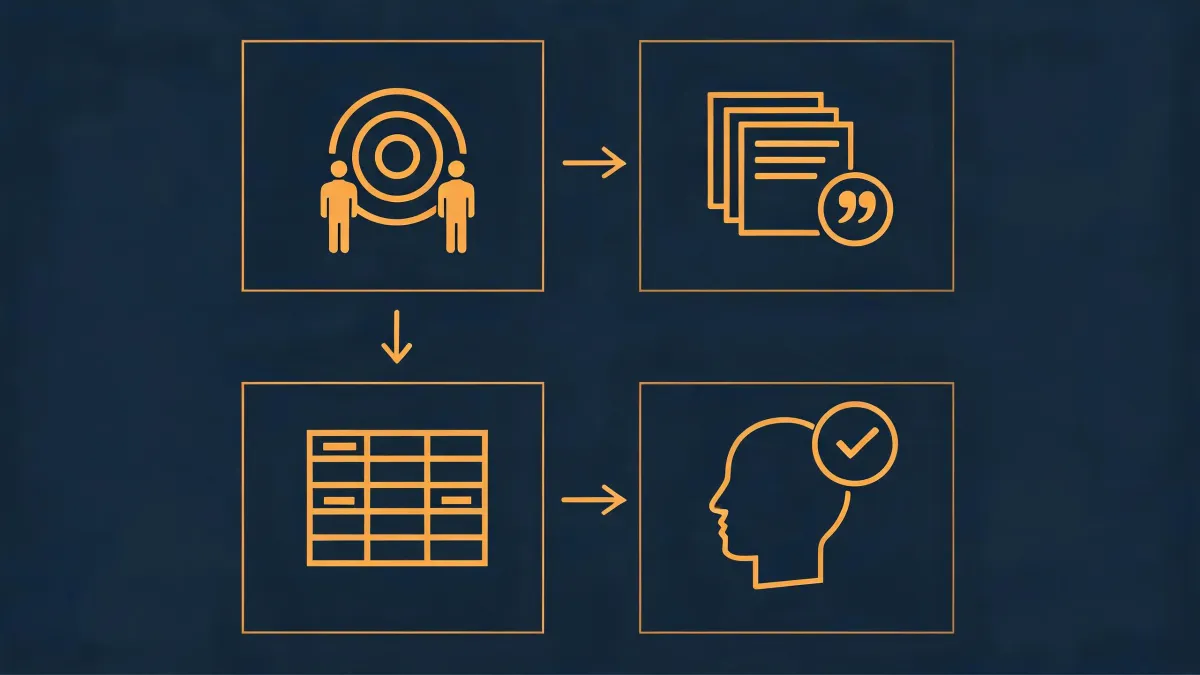
The real criterion is architectural. Scraping and enrichment are one segment of a longer chain. Without verification and review gating the tail end, a fast agent just produces bad data more efficiently — and the "alternatives" list you're building will keep growing.
Full disclosure: okkigo is one of the platforms I've evaluated in this category, and the questions above are the same ones I ran their setup through. I rolled them out to every other vendor too. The list is worth more than any single answer on it.