
I manage the sales technology budget for a ~120-person B2B company. For six years, I’ve been the one who reviews prospecting contracts, tracks renewal dates, and explains to finance why a stack of “small” tools never stays small. So when an SDR says, “Okki Go? That’s a sales prospecting skill,” I don’t get excited. I get suspicious.
Okki Go isn’t a sales prospecting skill. Not in the way that phrase gets used. A skill is a narrow action: scrape LinkedIn, find a work email, score a firmographic record. Okki Go sits above those skills. It is an agent-native prospecting workflow that combines multiple data sources, intent signals, and a human-in-the-loop outreach layer before anything is sent. That difference is not semantics. It changes how you should evaluate the purchase.
The surface problem: more tools, more handoffs, more hidden costs
When I audited our 2026 plan in late 2025, I found 13 tools that touched sales prospecting. Four of them enriched company data. Three found contact information. Two tracked anonymous website visitors. One called itself an AI BDR. Each quote seemed reasonable. Combined, the annual cost was enough to make finance raise an eyebrow.
But the real cost wasn’t the subscription fees. It was what happened between tools. An SDR exported a list from one source, uploaded it into an enrichment tool, saved the output as a CSV, and imported it into a sequencing platform. Each step added a chance for bad fields, stale emails, broken handoffs and lost context. The tools were doing their jobs. Nobody was responsible for the workflow.
The deeper reason: we keep treating prospecting like a single skill
Most of the tools I’ve reviewed are not bad at their narrow job. The problem is the mental model. We describe prospecting as “a skill” because that makes it easy to buy. It makes a messy process look like a drop-down menu: scrape contacts, enrich, send.
Real prospecting is not a sequence of independent actions. It is a loop with judgment at every step: choose the segment, decide which account is worth attacking this quarter, understand why now, identify the right contact, and then choose an outreach message that a human can stand behind. If you remove that judgment loop, you’re not prospecting. You’re generating volume.
A LinkedIn scraper is a start, not an outcome
Take the most obvious example: the LinkedIn scraper. It’s tempting to think that if sales reps have a list of 1,000 names from LinkedIn, the hard part is done. But any person who has actually run outbound will tell you the list is raw material, not a sales plan.
A list doesn’t tell you whether the company matches your ICP. It doesn’t tell you whether the person has budget, whether the account already exists in your CRM, or whether the visitor who just viewed your pricing page is a real opportunity or a competitor doing research. A scraper exports data. It does not decide what the data means.
That’s why “LinkedIn scraper” is not a prospecting strategy. In our stack, the scraping step was maybe 10% of the work. It got 100% of the attention because it was the part that looked automatable.
An AI BDR needs a human in the loop, not a bigger send volume
The phrase “AI BDR” hides the same trap. If an AI tool only automates sequences, it is an auto-mailer with a personality. A real BDR makes judgment calls: who to contact, why now, what to exclude, and what to do when someone says “not right now.”
Okki Go’s human-in-the-loop outreach isn’t just a compliance stamp. It is a feedback loop. A human can edit a segment, remove a bad account, block a persona, or rewrite a message. That feedback should change the next suggestion. Without that loop, an AI BDR is just a template that learns nothing from rejections.
I have mixed feelings about AI SDR products in general. On one hand, I’ve seen drafts generated in seconds that would take a rep twenty minutes. On the other hand, I’ve seen the same tools contact existing customers like they were new leads because the data layer was disconnected from the CRM. Human-in-the-loop outreach fixes that. It keeps a person responsible for the final message.
How website visitor tracking fits into an agent-native prospecting workflow
Website visitor tracking is often sold as a straight line: a company visits your pricing page, you see the company name, you reach out. In practice, the line is not straight. IP-to-company matching can be noisy, most visits are anonymous at the person level, and a single page view is not buying intent.
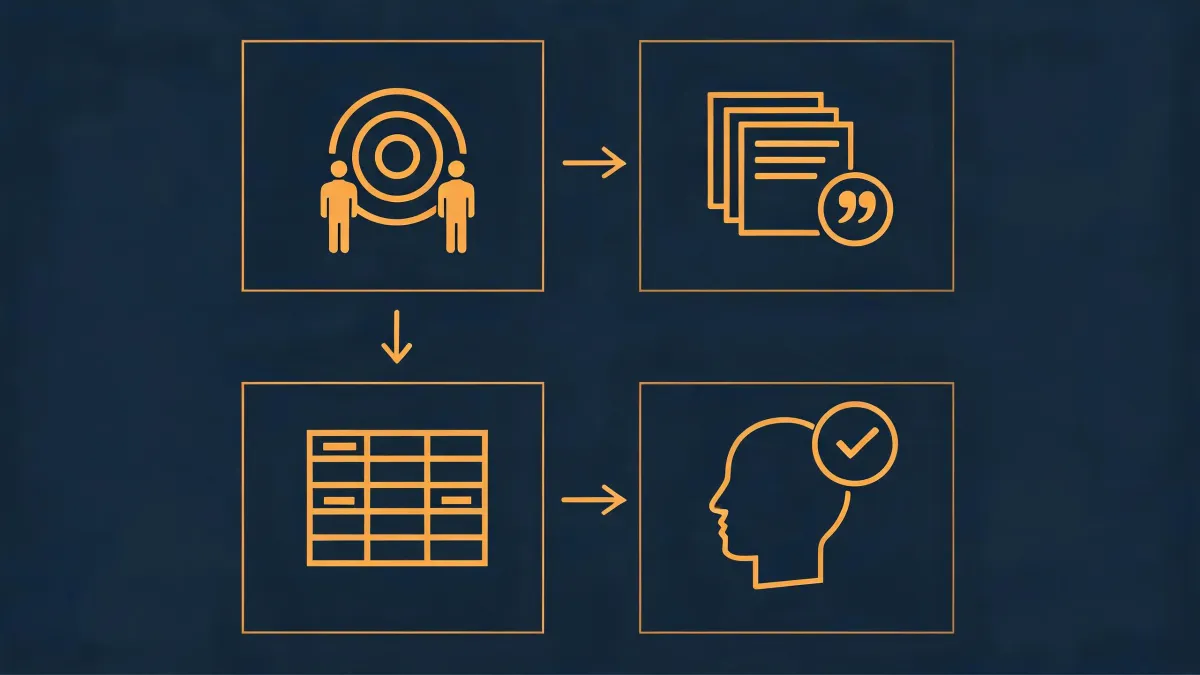
In an agent-native prospecting workflow, website visitor tracking belongs at the top. It is a signal that starts a series of steps: resolve the account, check whether it already exists in your CRM, score it against your ICP, enrich contacts through multiple sources, and then create an outreach task with a clear reason.
That is where waterfall enrichment matters. One data source might have the company’s headcount. Another might have a direct phone number. Another might show a recent funding event. An agent can try the most reliable source first, fall back when a record is missing, and flag low-confidence data instead of treating it as fact.
So how does website visitor tracking fit into an agent-native prospecting workflow? As a trigger, not a conclusion. When the agent detects a relevant account, it does the research-heavy work: find the right person, verify what can be verified, and present a human with a reason to reach out. The visitor tracking alone just tells you that someone looked. The workflow tells you whether that someone is worth a conversation.
The real cost of ignoring the workflow
When prospecting tools are purchased as point skills, your budget pays twice. You pay for data, then you pay for the time to clean it. You pay for AI, then you pay to fix the messages AI sends without context. You pay for intent data, then nobody opens the dashboard.
The most frustrating part for me is that none of this shows up in a single invoice. It shows up in the space between line items: the CSV cleanup hour, the duplicate records, the auto-renewal you forgot because the champion left the company. After six years of tracking every sales-tech invoice, I can tell you the overruns almost never came from the tool’s sticker price. They came from the handoffs.
What I’d evaluate instead of buying “a skill”
Okki Go is not a point skill. It is closer to an agent-native layer that runs multiple skills in one workflow: prospecting, enrichment, verification, intent, and human-in-the-loop outreach. If you only need a simple LinkedIn scraper, you don’t need that much. Buy the scraper and know its limits. But if you want to stop paying for eight tools that don’t talk to each other, the architecture matters more than the feature list.
When I evaluate a product like Okki Go, I don’t ask whether it can guarantee replies or replace the sales team. No credible tool should promise either. I ask whether it makes the next best action obvious. I ask what happens when a data source fails. I ask how a human can override the AI without breaking the workflow.
Okki Go isn’t a skill. It’s a workflow with a cost structure I can defend: fewer redundant tools, cleaner data handoffs, and a human still making the decisions that deserve human judgment. For a budget person, that’s the most important distinction of all.