
-
Are cheaper alternatives to Phantombuster actually cheaper?
-
What should you actually check on the Phantombuster pricing page?
-
Do I need a separate LinkedIn email finder, or is that built in?
-
What are website intent data features, and do I actually need them?
-
How does Sales Navigator export fit into an agent-native prospecting workflow?
-
When should you NOT use a tool like Phantombuster?
-
What's the real cost of switching tools — the one nobody puts on a spreadsheet?
I'm the person who broke our prospecting stack trying to save money. In early 2023, I convinced my team to switch from a tool that was working to a "cheaper alternative." The result: $3,400 in wasted budget, two weeks of pipeline slowdown, and a very awkward quarterly review.
Since then, I've documented every tooling mistake we've made. These are the questions people actually ask when they search for cheaper alternatives to Phantombuster — and the answers I wish I'd known before spending anything.
- Are cheaper alternatives to Phantombuster actually cheaper?
- What should you check on the Phantombuster pricing page?
- Do you need a separate LinkedIn email finder?
- What are website intent data features?
- How does Sales Navigator export fit into an agent-native prospecting workflow?
- When should you NOT use a tool like this at all?
- What's the hidden cost of switching tools?
Are cheaper alternatives to Phantombuster actually cheaper?
Short answer: it depends on what you count.
My mistake was counting the subscription only. I found a tool that cost about 60% less per month. It had a similar feature list. It promised the same output. I switched without running a real side-by-side test.
Here's what the comparison didn't include. The cheaper tool wasn't no-code in the same way. Phantombuster's model is "pick a skill, connect your account, press play." The alternative required me to configure selectors, debug parsing errors, and understand XPath (note to self: I was not qualified for that). I spent roughly 20 hours rebuilding automations that had taken 30 minutes to set up in Phantombuster. At a loaded cost of $75/hour for my time, that's $1,500 in labor — before we even talk about the subscriptions.
So no, the cheaper alternative wasn't cheaper. It was a lower monthly fee plus $1,500 of my time plus the opportunity cost of not doing actual prospecting for two weeks. That's when I fully understood the difference between sticker price and total cost.
To be fair, the other tool had a strength Phantombuster doesn't have — it handled one edge case in our workflow really well. But for the core purpose, the "cheaper" path cost more. The math only works if your time is worth zero.
What should you actually check on the Phantombuster pricing page?
The pricing page shows tiers, but the real information lives in the feature comparison. Three things I tell every team:
First, check the operation limits per plan. Each automation run consumes capacity, and plans have quotas. A team I consulted for bought the entry tier and hit the cap in a week because they didn't realize their scheduled automations ran every hour. The pricing page lists the quota; nobody reads that part until they get throttled.
Second, check which platforms your use case depends on. Phantombuster covers LinkedIn, Instagram, TikTok, Google Maps, Facebook, and others — but not every platform is in every tier. If your workflow is built around a platform in a higher tier, the lower-tier price is fiction for you.
Third, check integrations. We use n8n internally, and Phantombuster connects to n8n, Make, and Zapier. If the alternative you're evaluating makes you pay for a bridge or rebuild your automation logic, that's a hidden cost.
My rule now: the pricing page is a starting point, not an answer. I build a small test workflow with my actual use case on the free trial before I even look at annual plans. Ten minutes of testing saves a quarter of regrets.
Do I need a separate LinkedIn email finder, or is that built in?
This tripped me up, so I'll be direct: Phantombuster isn't sold as a LinkedIn email finder. It's an extraction platform. You use it to pull profiles from LinkedIn and Sales Navigator, and then you handle enrichment — finding email addresses — as a separate step.
The mistake people make (including me) is buying an email finder subscription before validating the extraction flow. I once bought a dedicated email finder, connected it to profile data we'd scraped, and then discovered our "company name" field was inconsistent — some rows had the parent company, some had subsidiaries, some had typos. The finder matched maybe 30% of what it should have. Thousands of rows, mostly useless.
The fix? Clean your data at the extraction level first. Phantombuster lets you control which fields the automation pulls and how they're labeled, so you can normalize company names, titles, and locations before enrichment ever happens. Do that once, and the email finder actually does its job.
Also — be skeptical of "verified" claims about emails. Per FTC advertising guidelines (ftc.gov), product claims need to be substantiated, and no third-party email source can honestly guarantee 100% accuracy. When a tool claims 95% or 99% verification, ask how they verify, then run a test yourself: send ten emails, watch the bounce rate. Vendors hate that test.
What are website intent data features, and do I actually need them?
Website intent data features are signals that tell you which accounts are poking around your site before they fill out a form. A company visits your pricing page three times, checks your integrations page, and reads your case studies. That's not random traffic — it's buying intent.
Phantombuster's website intent capabilities connect those signals to your prospecting workflow, matching anonymous site visits back to LinkedIn accounts. In practice, you find out a target account has been researching you for a week. That changes how you open the conversation.
Do you need it? Depends on your outbound model. If you're a small team sending 50 emails per week, intent data is a nice-to-have, not a priority. If you're running ABM against a specific list of accounts, it's practically a cheat code. We use it to rank: accounts with recent site activity go to the top of the queue, everyone else waits.
The efficiency angle matters here. Intent signals decay fast — the person who visited your pricing page on Tuesday has moved on by Friday. If your process can't act on the signal within a few days, you're paying for information you're not using. (For us, automation is the only reason intent data works — the system surfaces the account before anyone has to notice it.)
How does Sales Navigator export fit into an agent-native prospecting workflow?
People hear "agent-native" and assume the old tool stack disappears. It doesn't. Agents need data, and Sales Navigator is one of the best sources for the data agents need most: who your ICP is and where to find similar accounts.
Here's how it connects in our setup:
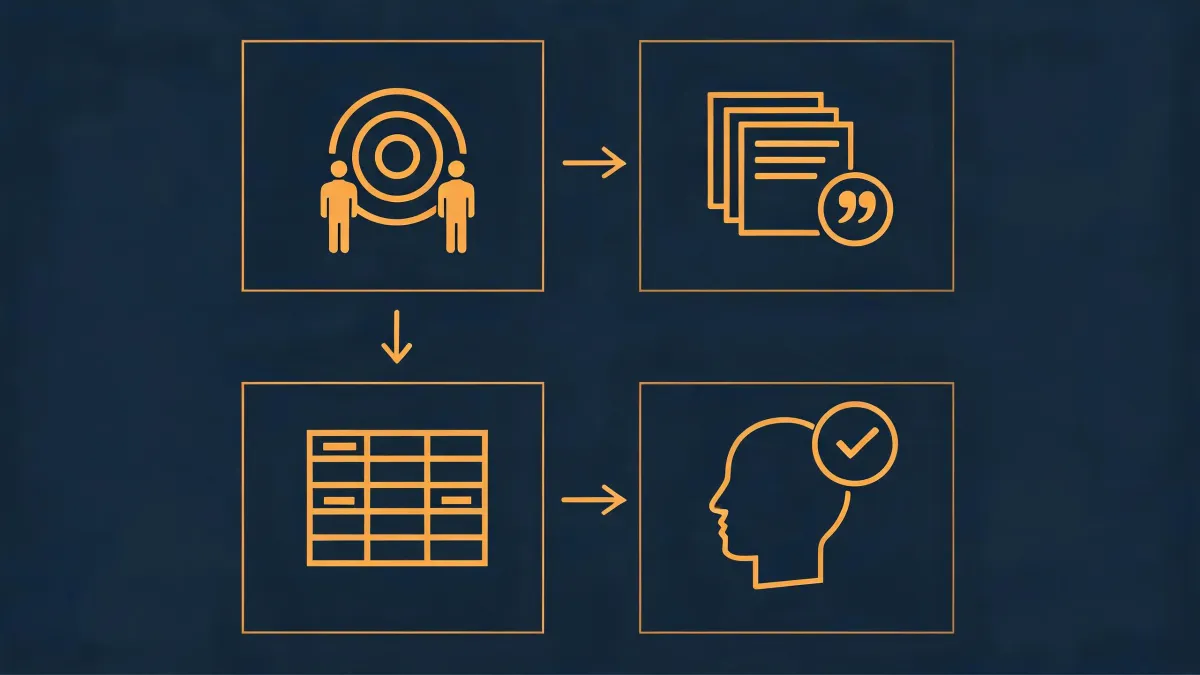
Sales Navigator search — saved searches and boolean strings we've refined for months — feeds a Phantombuster automation that exports profiles at scale. The export goes into our enrichment pipeline, where an email finder and data verification layer fill the gaps. From there, an agent personalizes the first touch for each prospect based on role, company size, and recent activity. Then the outreach tool sends the sequence.
The export is the feeding stage. If it's slow, broken, or manual, everything downstream starves.
Sales Navigator is excellent at finding the right people. It's not built for bulk extraction — that's a different job, and it's not a criticism of Sales Navigator to say so. Tools like Phantombuster exist to bridge that gap: they turn a hand-built list into a structured, machine-readable input that an agent workflow can consume.
A few years ago, the export was the endpoint. Someone saved a CSV and started manually emailing. Now it's the starting line. The agent-native workflow treats the export as infrastructure, and that shift changes what you should demand from your export tool: consistency, clean formatting, and the ability to run on a schedule without someone supervising it.
Honestly, I'm not sure every team needs an agent-native workflow. But if you're exploring that path, the Sales Navigator export isn't an afterthought — it's the foundation.
When should you NOT use a tool like Phantombuster?
I'll say the unpopular thing: some teams shouldn't use a no-code extraction tool at all.
If your compliance team requires signed assurance that your data extraction is fully compliant with every platform's terms of service, you won't get that from this category of tool — not from Phantombuster, not from any alternative, not from a custom solution. There's always some degree of risk when you automate platform data collection. Nobody who's honest will guarantee zero account risk. If you can't operate with that uncertainty, build a manual workflow or don't do it.
If your data operation runs at massive scale — millions of records a day — a no-code platform is the wrong layer. You're better off with direct APIs and a data engineering team.
And if your need is genuinely once a month — "I just want a list of restaurants from Google Maps" — don't buy a subscription at all. Use a free trial or hire someone for a day. The subscription math only works if you're running extractions regularly.
This setup works for us because we're a 12-person B2B team with a clearly defined ICP and steady outbound volume. If your situation is different — huge org, infrequent need, zero tolerance for platform risk — the calculus changes.
What's the real cost of switching tools — the one nobody puts on a spreadsheet?
The most frustrating part of tool evaluation isn't the tools. It's that every vendor's website makes switching sound like a 5-minute job. Export your data, update your settings, you're done. It has never taken me 5 minutes.
The costs that never get priced in:
The data archaeology. Exported CSVs are never clean. Field mappings don't align, values are formatted differently, duplicates hide in plain sight. Every migration I've done included at least a week of dataset cleanup before we could trust the new stack.
The muscle memory loss. You don't just lose the tool — you lose the accumulated knowledge of how you configured it. The Phantombuster skill you spent a rainy Thursday figuring out — the variable syntax, the reusable custom field, the exact schedule that avoided rate limits — you'll have to discover all of that again in the new tool.
The trust debt. During a migration, nobody on the team fully trusts the new data. That means more manual checking, which means less outreach, which means a dip in pipeline. We tracked a three-week output drop during our last migration. That's the most expensive part, and it's invisible on any pricing page.
So here's my actual advice: unless there's a clear trigger — the tool is broken, the price increase exceeds the value, the platform no longer solves your core problem — switching to chase a lower subscription is a bad trade. I made that trade twice in 14 months. I really should have documented the first one before I repeated it.