
API company data belongs upstream of your prospecting agent, not downstream. Data first, agent second. When we flipped that order in our own okkigo setup, the lists our agent started building finally matched what the sales team actually wanted to call. Before that, we were using API data to check the agent's picks — instead of using it to shape what the agent knew about in the first place.
That ordering sounds like a technicality. It isn't. The dataset your agent has determines the decisions it can make, and its decisions are what show up in your SDRs' mornings.
Why I'm the one writing this
I'm the office administrator and procurement lead at a 180-person B2B software company. I manage the sales tooling contracts — about $140k annually across nine vendors, give or take. (Probably $125k, I'd have to check the latest renewal sheet.) Ops and finance both have to sign.
I took over this stack in 2022. I've now been through three "this tool will change everything" cycles, and two of them actually improved things. We brought okkigo in during August 2025. The trigger: our SDR team kept complaining that most of the accounts they were working simply weren't going to reply — wrong stage, wrong size, wrong everything.
Before that, our prospecting setup was: Sales Navigator exports, an email list from a vendor, and a spreadsheet we scrolled through by hand. Not quite manual, but close enough that nobody called it automated.
What "agent-native prospecting" actually means
My understanding — and I'm not a technical person, I just buy a lot of this stuff — is that agent-native means the agent handles the workflow. Who enters a sequence, when, at what angle, and when to stop. Traditionally that's a human running tools. You pull a list, apply filters, build a sequence, and hope you filtered right. Agent-native means the loop can run on signals continuously, with humans stepping in at key points (i.e., the human-in-the-loop checkpoints).
That only works if the agent has data. No data, it guesses. Bad data, it guesses confidently — and in a workflow you've delegated to it.
Where I first put API company data (and why it was wrong)
In our original architecture, company data sat pretty far downstream. Custom field in Salesforce. The list came in from Sales Navigator, got enriched, then went to the agent.
Meaning: the agent picked companies based on thin signals — industry, headcount, whether they had a decent LinkedIn presence. Then our API data kicked in to "verify and complete" those records. By the time the data landed, the list was already set. It could fix a phone number. It couldn't change anything real.
It took me way too long to see how dumb that was. I knew I should wire the data pipeline first, but I thought, "what are the odds it matters?" Well — third week in, the odds caught up. Roughly 40% of what we were calling "target accounts" were either current-product users or competitors' customers. Those should have been filtered out at the very start.
The okkigo setup we ended up with
I can't say this generalizes to every stack. But here's the order that's working for us:
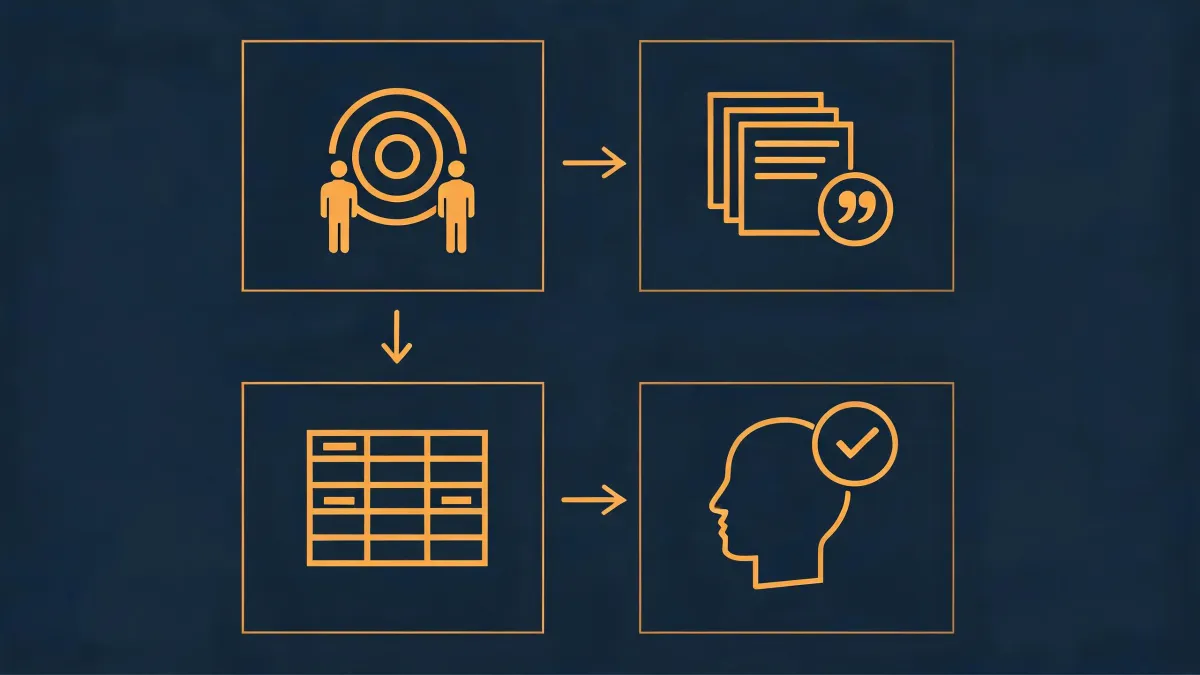
- Intent signals come in first. Job postings, funding announcements, product launch posts.
- API company data layers on top for enrichment and filtering — not just "right size," but "right size, raised a Series B in the last 12 months, posted 12 sales roles in the past 60 days."
- The agent builds the sequence from that filtered pool.
- Human review before anything sends — more on this below, because we got it wrong.
That fourth step is the one we skipped initially. Figured the agent, with solid data behind it, would just… run correctly. It didn't.
I'll tell you about the specific miss because it's instructive: on about our third or fourth sequence launch, a subsidiary of a Fortune 500 competitor — same brand-domain pattern in the automation check — was tagged as "mid-market" because of a rule I never reviewed. The SDR working that sequence spent two hours trying to figure out why one company kept showing up in his queue.
Not a catastrophe. But it ate a morning, and it made the sales lead less trusting of the agent before we'd earned it.
That wasn't the data's fault. That was us not having a defined human-review step. No escalation path. No clarity on who was supposed to check sequences before they went out. No rules for what to do when the agent came back with lower confidence. The default was trusting the agent. Bad default.
What the human-in-the-loop step actually does
Not approve everything. That would just be manual again. Our version: the agent generates a sequence, and an SDR scans it before it sends. Takes maybe 10 to 15 minutes per launch. If something looks off, they flag it and we tune the filter the following week.
The reason this works is the weekly review. Not monthly. Twenty minutes every Friday going through what the data flagged or missed beats discovering problems at quarterly review — by which time you've already sent 400 emails and you're explaining, not fixing. (Note to self: actually document the escalation rules next quarter.)
One compliance thing I want to flag, because we learned it the awkward way: if you're making performance claims in your outbound — human-written or agent-drafted — FTC advertising guidelines apply. Per FTC guidelines (ftc.gov), claims must be truthful and not misleading, and you need substantiation. So if your agent drafts something like "we tripled booked meetings for companies like yours," you'd better be able to back it up. That's not a copy problem. That's a compliance one.
What this doesn't fix
Two things I wish someone had told us straight.
First, it doesn't fix a team that doesn't know its ICP. Not the PowerPoint version — the real one, the one that actually pays. We started with that problem. You can enrich a target list built on wrong signals, but what you get is a better-enriched wrong list. Data amplifies whatever you already know. Includes the bad parts.
Second, if your volume is small, this is overkill. If you're sending fewer than 15-20 sequences a month, you don't need an agent-native workflow. You need someone with 20 minutes on LinkedIn doing actual research. I genuinely wish we'd been told that a year ago instead of buying tooling.
And one more thing, which may just be us: it hasn't replaced our RevOps lead. The cleanup work he was doing is still being done, just somewhere different. He spends less time deleting bad records and more time defining what good records look like. The hours got moved, not removed.
I can't speak to your stack. And I can't tell you how okkigo will land for your team. What I can tell you is that moving the data upstream of the agent was the single change that mattered most in our setup. Just that one change.